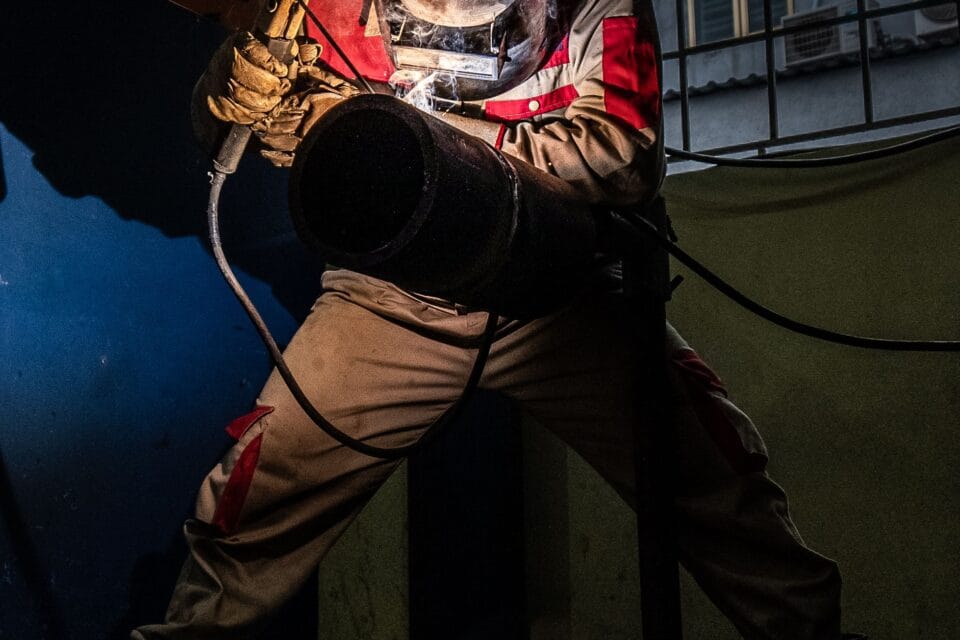
Key takeaways
- A WPS tells the welder how to make the weld: process, materials, consumables, positions, preheat and parameters.
- A WPQR proves that the WPS produces a sound weld with the required properties, through a test piece and its test results.
- A WPQ (welder qualification) proves that a specific welder can make that type of weld.
- Under ISO standards: WPS in ISO 15609, procedure qualification in ISO 15614, welder qualification in ISO 9606.
Welding procedure qualification is the foundation of every welded structure, yet the three documents behind it are often confused. A client asks for “the WPS”, an auditor asks for “the WPQR”, the site asks whether the welders are “qualified”. This guide explains what a WPS, a WPQR and a WPQ are, how they relate to each other, which standards apply, and the mistakes that most often lead to rejected welds or failed audits.
What is a WPS (welding procedure specification)?
The WPS is the working instruction for a weld. It defines everything the welder needs to reproduce a sound joint: the welding process, base material group and thickness range, joint design, filler material and shielding gas, welding positions, preheat and interpass temperature, heat input, and the electrical parameters for each pass. Under ISO rules the content of a WPS for arc welding is set out in ISO 15609-1.
Before qualification, the document is a preliminary WPS (pWPS). It becomes an approved WPS only once it is supported by a qualification record, most often a WPQR.
What is a WPQR (welding procedure qualification record)?
The WPQR documents that the procedure works. A test piece is welded following the pWPS, under the supervision of an examiner or examining body, and then tested: visual testing, non-destructive testing, and destructive tests such as tensile, bend, macro examination, hardness and, where required, impact tests. If the results meet the standard, the WPQR is issued and one or more WPSs can be written within its range of qualification.
For arc welding of steels and nickel alloys, ISO 15614-1 defines the test piece, the tests and the range of qualification: the thicknesses, diameters, material groups, positions and other variables the WPQR covers. In ASME practice the equivalent record is the PQR, qualified to ASME Section IX.
What is a WPQ (welder qualification)?
A qualified procedure is not enough: the person holding the torch must also be qualified. Welder qualification tests the welder’s skill, not the procedure. Under ISO 9606-1 (steels) the welder makes a test piece that is examined visually and by NDT or destructive tests. The certificate states the process, material group, product type, thickness and diameter range, and positions in which the welder may work. Operators of mechanised and automatic welding equipment are qualified to ISO 14732.
WPS vs WPQR vs WPQ at a glance
| WPS | WPQR | WPQ | |
|---|---|---|---|
| Question it answers | How do we weld this joint? | Does the procedure produce a sound weld? | Can this welder make this weld? |
| Main ISO standard | ISO 15609 | ISO 15614 (by test) | ISO 9606 / ISO 14732 |
| ASME equivalent | WPS | PQR (Section IX) | WPQ (Section IX) |
| Who uses it | Welder, coordinator, inspector | Engineer, auditor, client | Coordinator, inspector |
| Tied to | One or more WPQRs | Test piece and results | A named welder |
Other ways to qualify a procedure
A procedure test to ISO 15614 is the most common route, but ISO 15607 also allows qualification by tested consumables (ISO 15610), previous welding experience (ISO 15611), a standard welding procedure (ISO 15612) or a pre-production welding test (ISO 15613). The application standard or the contract decides which routes are acceptable. For critical work such as pressure equipment and offshore structures, a procedure test is usually required.
Common mistakes that cause rejections
- Welding outside the range of qualification: a thickness, diameter or material group not covered by the WPQR.
- Heat input outside the qualified limits when impact or hardness requirements apply.
- Changing an essential variable, such as the filler classification or shielding gas, without a new qualification.
- Expired welder certificates: ISO 9606-1 requires periodic confirmation of the welder’s continued work within the range.
- A WPS on site that differs from the approved revision, or no WPS at the workstation at all.
Practical tip: build a WPS/WPQR matrix at the start of the project that maps every joint type on the drawings to a qualified WPS. Gaps become visible before production, not during an audit.
Who is responsible?
Preparing the pWPS, planning the qualification tests and writing the WPSs is the job of the welding engineer or welding coordinator, typically an IWE/EWE under ISO 14731. The examiner or examining body witnesses the test and certifies the WPQR and welder qualifications. See our welding engineering services and welding coordination. The ISO catalogue lists the current edition of each standard mentioned here.
Our IWE/EWE-certified engineers prepare pWPSs, plan and follow the qualification tests and build the WPS matrix for your drawings.
Frequently asked questions
Does a WPQR expire?
Under ISO 15614-1 a WPQR does not have a fixed expiry date. It remains valid as long as welding stays within its range of qualification and the application standard or contract does not require requalification.
Can one WPQR support several WPSs?
Yes. Several WPSs can be written from one WPQR, as long as each stays within the range of qualification of that record.
Is a WPS enough without a WPQR?
No. A WPS must be supported by a qualification route accepted by the application standard, most often a WPQR from a procedure test.
How often must welders renew their qualification?
ISO 9606-1 requires the welding coordinator or examiner to confirm every six months that the welder has worked within the range, and the qualification must then be revalidated periodically according to the option chosen on the certificate.